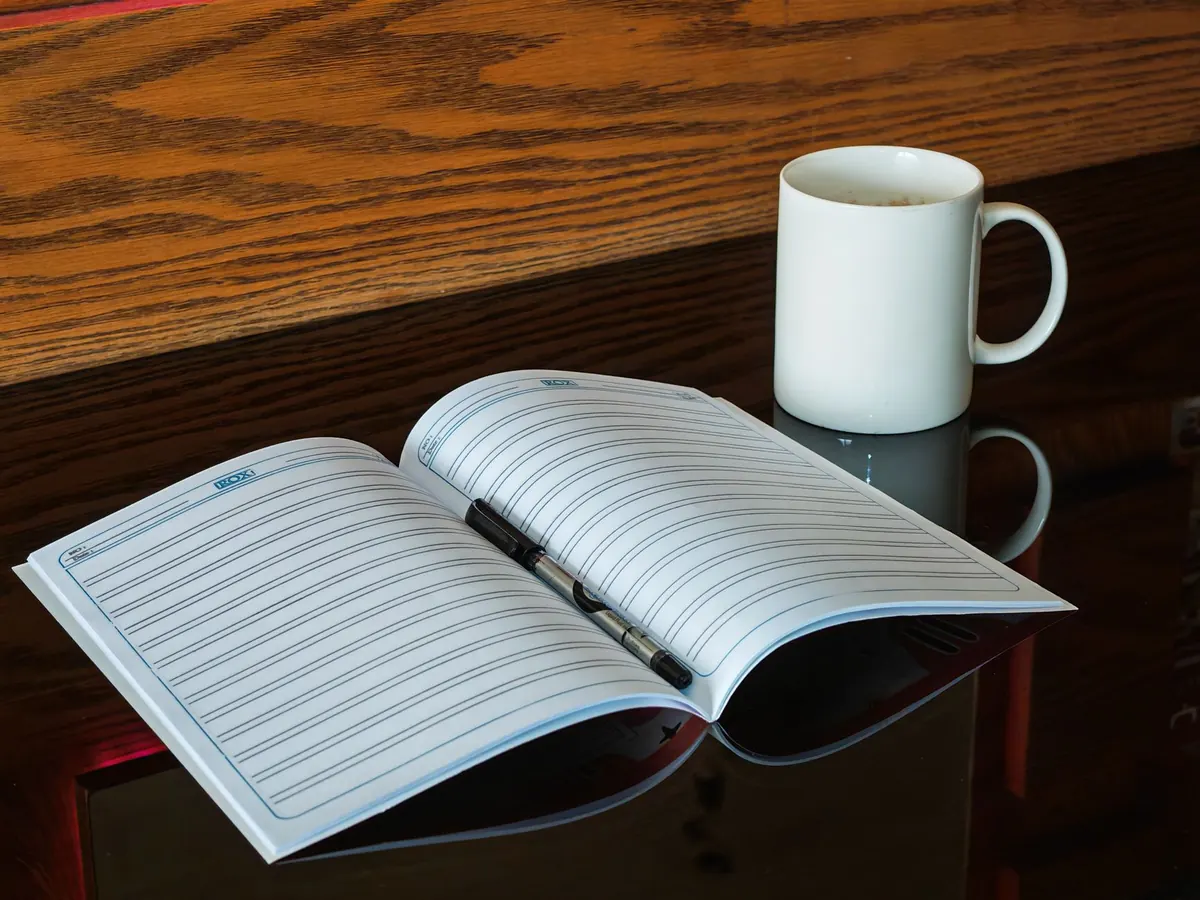
How to Start a Journaling Habit in 10 Minutes a Day
Most people who decide to start journaling aren't short of things to say — they're short of time, and the picture in their head doesn't fit a normal Tuesday. A leather notebook. A quiet hour. Tea going cold. Ten minutes is a different proposition: long enough to write something useful, short enough that you'll still do it on the evening when work overran and the washing machine is mid-cycle.
Why ten minutes is enough
A short entry you write most days beats a long one you write twice a year. The value is in the repetition, not the word count. Regular writing gives you a record you can look back on, and it lets you spot patterns you'd otherwise miss: the weeks you sleep badly, the tasks that drain you, the idea that keeps returning.
Ten minutes is roughly 150 to 250 words in longhand, and more if you type. That's enough room for a proper think. If you sometimes have half an hour and want to use it, use it. Just don't make half an hour the baseline, because the days you can't manage it are the days the habit quietly dies.
Set up before you sit down
Friction, not motivation, decides whether a habit survives. Sort the small obstacles in advance:
- Pick one place to write. A notebook on the kitchen table or an app on your phone, not both. Two homes means you're always reaching for the wrong one.
- Leave it visible. A journal in a drawer is a journal you forget.
- Use a pen you like. Cheap is fine. Scratchy and hated is not.
- Attach it to something you already do. After the kettle boils, on the train, once the children are down.
- Decide what happens to your phone. If you're writing on paper, leave the phone in another room. If you're writing on the phone, use a plain notes app and aeroplane mode.
What to do with the ten minutes
You don't need a clever system. A simple three-part shape stops you staring at a blank page.
Minutes 0–2: empty your head
Write down whatever is at the front of your mind, in whatever order it arrives. A half-finished email. The thing you said in a meeting. The fact that you need to ring the dentist. This isn't the interesting part; it's clearing the runway.
Minutes 2–7: one thing, properly
Choose one item from that list and stay with it. What actually happened? What did you think at the time, and what do you think now? If another person was involved, what might they have been seeing? Five honest sentences beat a page of summary.
Minutes 7–10: one line forwards
Finish with a single sentence about what happens next. "Ring the dentist tomorrow morning." "Ask for the deadline in writing." "Nothing — I just needed to say it." All three are valid.
Three routines you can copy
If that shape feels too loose, borrow one of these instead.
- The commute download. On the way home, write about the day you've just had. What took more out of you than it should have? What went better than expected? By the time you walk through the door, the day is on the page rather than in your head.
- The three-line evening. One thing that happened, one thing you felt, one thing you want tomorrow. Three lines, no more. Good for days when you're too tired for anything else but still want to keep showing up.
- The Sunday ten. Once a week, look back over the last seven days and write about what you want the next seven to look like. Ten minutes is enough to notice you've said yes to three things you didn't want to do.
Where the ten minutes actually comes from
Nobody finds ten spare minutes; you borrow them. Look at the gaps that already exist — the wait for the kettle, the last ten minutes of a lunch break, the stretch between getting home and starting dinner, the time in bed before you reach for your phone.
That last one is worth being honest about. If you spend twenty minutes scrolling before sleep, you already have the time. Swapping ten of those minutes for a page of writing is a far smaller change than adding a new activity to an already full day.
When you miss a day, or get stuck
Missing a day
One missed day is nothing. Two in a row is where habits wobble, so give yourself a rule: never miss twice. Don't try to catch up on entries you didn't write, and don't start a fresh notebook next month to make it tidy. Sit down, write three lines, carry on as though nothing happened.
"I don't know what to write"
Write about not knowing what to write, or answer one of these: What's taking up the most room in my head today? What do I keep putting off? What went well in the last twenty-four hours? What would I say if I weren't being polite? Prompts beat waiting for inspiration.
"I'm worried someone will read it"
Keep it somewhere private, or use a locked notes app. You can also agree with yourself that anything truly sensitive goes on a loose sheet you destroy afterwards. The aim is to write as though nobody is marking it.
Your first week
Choose one slot, one place to write, and one of the routines above. Do it for seven days, even if some entries are three lines long and several are dull. Then read back through the week — not to judge the writing, but to see whether you noticed anything you'd otherwise have forgotten.
After that, change one thing. Ten minutes too long on weekdays? Drop to five and keep the full ten for Sunday. Evenings not working? Try the morning instead. The habit that lasts is the one you've reshaped to fit your actual life, not the life you wish you had.
One last note: writing things down can be a genuinely useful way to handle everyday stress and think more clearly, but it isn't a substitute for proper support. If you're struggling with your mental health, speak to your GP or another qualified professional.
Photo: Mahmoud Zakariya / Pexels

You Might Also Like
A practical, stripped-back guide to starting a bullet journal: the three supplies you need, four pages worth setting up, and a routine that keeps it going.
Fifty cosy, weather-inspired journal prompts for slow rainy Sundays indoors, plus tips for setting the scene and using them without turning reflection into homework.